BREAKING: Train Collision Near Machu Picchu
Severe Train Collision Near Machu Picchu — Service Suspended Indefinitely - - -Train Collision Leaves One Dead and Dozens Injured
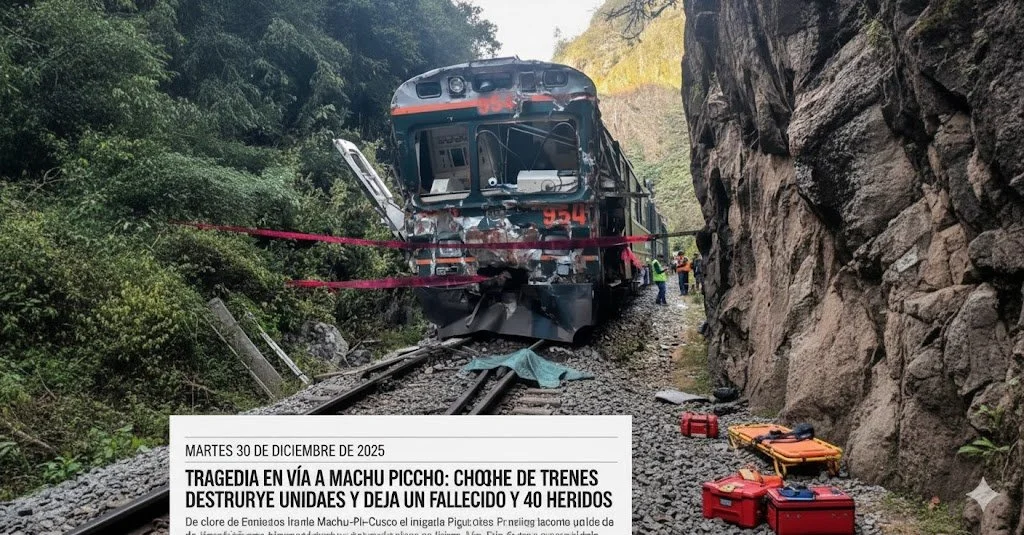
Location: PK 94+200, Pampacahua Sector (near Qoriwayrachina) Date: December 31, 2025 (Updates from Dec 30 incident)
Following a severe head-on collision between two trains on Tuesday, December 30, 2025, rail service connecting the historic site of Machu Picchu to the city of Cusco has been suspended indefinitely. Authorities and regional experts warn that the scale of the damage and the complexity of the investigation could mean it will take months to fully reopen the line.
Key Details of the Accident
Location: Near Qoriwayrachina (Kilometer 94/98), a remote archaeological site between Ollantaytambo and Aguas Calientes.
Time: The collision occurred at approximately 1:20 PM local time.
Casualties: One train driver (a railway worker) tragically lost his life.
Injuries: Between 30 and 40 passengers were injured, including American and Chinese nationals; at least 20 are reported to be in serious condition.
Damage: Both locomotives—operated by PeruRail and Inca Rail—suffered massive frontal impacts and are currently blocking the single-track corridor.
Extended Service Suspension
The rail line is the primary artery for the 4,500 visitors who visit the UNESCO World Heritage site daily. However, several factors suggest a long-term closure:
Forensic Investigation: The Peruvian Public Ministry has opened a formal investigation into the causes of the head-on crash on the single-track line.
Track Recovery: The accident occurred in a geographically challenging area hemmed in by lush forest and massive rock faces. Removing the destroyed, multi-ton locomotives without direct road access is a major engineering hurdle.
Safety Overhaul: Following the tragedy, there is mounting pressure to upgrade the signaling and safety protocols on the route, which may delay the resumption of commercial traffic for months.
Impact on Tourism
The suspension has left hundreds of travelers stranded in Aguas Calientes and forced thousands more to cancel New Year's plans.
Bimodal Services: While some "bimodal" (bus + train) services typically use various transfer points, the total blockage at Kilometer 94 effectively severs the main link to the citadel.
The Inca Trail: Walking to the site remains the only alternative, though the trek from Ollantaytambo takes four days and requires strict permits.
With the rail line between Ollantaytambo and Machu Picchu expected to be closed for months following the December 30, 2025 collision, your options shift toward overland road routes and multi-day treks.
Since you are often traveling by truck in South America and planning routes for your blog, Rutas Fotos Info, or the Andes Explorer project, these alternatives offer significant photographic and "overlanding" appeal, though they require more logistical planning than the standard train.
1. The "Hydroelectric" Route (Overland)
This is the most popular non-train alternative. It involves a long drive/bus ride around the mountains to approach Machu Picchu from the "back" (the jungle side).
The Route: Cusco → Santa María → Santa Teresa → Hidroeléctrica.
The Drive: Approximately 6–7 hours from Cusco. It crosses the Abra Málaga pass (4,316 meters), offering dramatic views for photography before descending into the high jungle.
The Walk: Once at the Hidroeléctrica station, you must walk 11 km (about 2.5–3 hours) along the flat jungle railway tracks to reach Aguas Calientes (Machu Picchu Pueblo).
Status: This route is likely to become extremely crowded now that the main train line is down.
2. Multi-Day Trekking Routes
With the trains out of service, trekking is the only way to reach the citadel "directly" through the mountains.
The Salkantay Trek (4–5 Days): Often cited by National Geographic as one of the best in the world. It passes the sacred Salkantay peak and Humantay Lake. It eventually connects to the Hidroeléctrica route.
The Inca Jungle Trek (4 Days): A more "adventurous" multi-sport route involving mountain biking, rafting, and hiking. It also ends at the Hidroeléctrica walk.
The Lares Trek (3–4 Days): A more cultural route passing through remote Andean villages. It usually requires a short train ride at the end, but with the suspension, operators will likely pivot to hiking the final stretch from Ollantaytambo or using the Santa Teresa road.
3. Emergency & Bimodal Services
Bimodal Transfers: Keep an eye on PeruRail and Inca Rail updates. They often set up "Bimodal" services where buses take you as far as possible (likely to the Piscacucho/KM 82 area or via Santa Teresa) to bypass the damaged section of the track.
The "Inca Trail" (KM 82): If you already have permits, the 4-day classic trek is unaffected by the rail closure as it starts at KM 82 and enters the site through the Sun Gate.
As of December 31, 2025, the Peruvian government and local authorities have activated the Tourist Protection Network (Red de Protección al Turista) to manage the evacuation of thousands of tourists stranded by the head-on collision.
Because the crash occurred on a single-track section in a remote Andean area with no direct road access, evacuation efforts are complex.2 Here are the latest updates on the emergency plans:
1. Evacuation of the Injured
Ambulance Deployment: More than 20 ambulances have been deployed to the Piscacucho sector (Kilometer 82), which is the closest point reachable by road.
Triage & Transport: Injured passengers are being carried by stretchers from the crash site to the road-accessible areas and then transferred to clinics and hospitals in Cusco and Urubamba.
Serious Conditions: Local health officials report that approximately 20 people are in serious condition, including foreign nationals (specifically mentioned were four Chinese tourists and several Americans).
2. Plans for Stranded Tourists
For the thousands of uninjured tourists currently at Machu Picchu Pueblo (Aguas Calientes) or Ollantaytambo, the following protocols are in place:
Overnight Accommodations: The Ministry of Foreign Trade and Tourism (Mincetur) is coordinating with local hotels and the municipality of Machu Picchu to provide support for those unable to leave.
Alternative "Safe Passage": While rail service is suspended "until further notice," authorities are evaluating a "pedestrian bridge" or safe walking corridor past the accident site (KM 94) to allow tourists to walk to KM 82, where buses can meet them.
Helicopter Support: While not yet a mass evacuation method, regional authorities are discussing airbridge options for high-risk individuals (elderly, pregnant, or those with medical needs) if the track remains blocked for more than 48 hours.
3. Official Contact & Support
If you or anyone you know is affected, the Peruvian government has provided direct emergency lines:
iPerú Assistance: +51 944-492-314 (available 24/7 for tourist support).
Consular Services: Most major embassies (US, Canada, China) have activated their emergency watch centers to assist their citizens in the Cusco region.




For your Planning:
If you asked me for my honest take: given the tragic fatality and the massive damage to these locomotives—which weigh dozens of tons—removing the wreckage from such a narrow gorge is going to be a slow, grueling process. Historically, even with 'simple' landslides in this region, it has taken several days just to clear enough debris for a single train to pass.
With a collision of this magnitude, we aren't just looking at clearing tracks; we’re looking at a complex recovery and a major forensic investigation. For those of you planning to reach the citadel, it's time to start looking seriously at the Santa Teresa overland route or the mountain treks, because this line won't be moving anytime soon.
Several reliable bus and shuttle companies in Cusco specialize in the "Machu Picchu by Car" route, which drops passengers at Hidroeléctrica. This is a common alternative for travelers avoiding the train or facing service interruptions.
Recommended Bus & Shuttle Companies
Based on recent traveler reviews and current availability (as of late 2025), the following companies are recognized for reliability on this specific route:
CompanyKey FeaturesDeparture Point in CuscoSakura ExpeditionHighly rated for safety and punctuality; offers both tourist vans and private cars.Most departures are near the Historic Center or Plaza Regocijo.Machupicchu by busDedicated specifically to this route with frequent daily departures.Typically departs from the Cusco Historic Center.HidroBusTransparent pricing (approx. $15 USD one-way) and easy online booking.Pick-up from accommodation or Plaza Regocijo.Platinum Class (Enjoy Peru Holidays)Features smaller groups (14 seats), reclining seats, and Wi-Fi.Usually departs from Plaza Regocijo.Machupicchu ExpressKnown for experienced drivers who navigate the narrow Santa Teresa roads daily.Centrally located boarding points.
Practical Travel Details
Departure Time: Most shuttles depart Cusco between 6:00 AM and 7:30 AM. It is a 6 to 7-hour journey.
The Route: You will travel through the Sacred Valley, over the high Abra Málaga pass (4,316m), and down into the jungle brow. The final stretch from Santa Teresa to Hidroeléctrica is a bumpy dirt road.
Return Trip: Shuttles back to Cusco typically depart from the Hidroeléctrica gate between 2:30 PM and 3:00 PM.
The Hike: From Hidroeléctrica, you must walk approximately 10km (2.5–3 hours) along the train tracks to reach Aguas Calientes (Machu Picchu Pueblo).
Current Status & Safety (December 2025)
As of December 30, 2025, there have been reports of train service interruptions in the Pampacahua sector due to an accident. This has increased demand for the Hidroeléctrica route.
Booking: It is highly recommended to pre-book your ticket online via platforms like redBus.pe or directly with the operators above to ensure a seat.
Road Conditions: December is the rainy season. Expect potential delays due to mud or minor landslides on the unpaved section near Santa Teresa. If conditions are severe, some companies may suspend service for the day.
Pro-Tip: If you cannot find a direct tourist shuttle, you can take a local bus from the Santiago Bus Terminal in Cusco to Santa Maria, then a "colectivo" (shared taxi) to Santa Teresa, and another to Hidroeléctrica. However, for those needing a reliable exit, the direct tourist shuttles listed above are much more straightforward.